Tot nu toe hebben we gewerkt met een simpel lineair regressiemodel met maar één predictor of feature om de target waarden te voorspellen. In het algemene geval , kunnen we de voorspellingen echter koppelen aan meerdere features in de design- of feature-matrix . Hier illustreren we de OLS en gradient descent oplossing in het geval waarbij we drie features hebben.
Data simulatie
We blijven bij dezelfde simulatie van de fooi die klanten bovenop een bestelling in een koffiehuis betalen zodat we exact weten wat de optimale parameterwaarden zijn waar we naar op zoek zijn. We simuleren nu een situatie waarbij de fooi tot stand komt door een lineaire combinatie van () het order volume (in dollars), () de leeftijd van de klant (in jaren) en () de hoeveelheid regen (millimeter/dag):
waarbij we het intercept of de bias termen weglaten in de notatie.
Voor de simulatie gebruiken we concreet:
Source
import matplotlib.pyplot as plt
import numpy as np
from sklearn.preprocessing import StandardScaler
Source
# Set style for prettier plots
plt.style.use("seaborn-v0_8")

rng = np.random.default_rng(42)  # Create a random number generator

# Simulate realistic coffee shop data
n_customers = 50

# True relationship:
b1 = 0.50
b2 = 0.15
b3 = 0.05
b4 = -0.003
noise_std = 0.30

# Generate feature values
order_totals = rng.uniform(3, 25, n_customers)
age = rng.uniform(0, 70, n_customers)
rain = rng.uniform(0, 200, n_customers)

# Generate corresponding tip amounts with realistic noise
true_tips = b1 + b2 * order_totals + b3 * age + b4 * rain
tip_noise = rng.normal(0, noise_std, n_customers)
observed_tips = true_tips + tip_noise
observed_tips = np.maximum(0, observed_tips)  # Tips can't be negative
Source
# Create a figure with three subplots
fig, axes = plt.subplots(1, 3, figsize=(15, 4))

# Plot 1: Order Total vs Tip
axes[0].scatter(
    order_totals,
    observed_tips,
    alpha=0.7,
    color="saddlebrown",
    s=60,
    edgecolor="white",
    linewidth=0.5,
)
# Add OLS trendline
z1 = np.polyfit(order_totals, observed_tips, 1)
p1 = np.poly1d(z1)
axes[0].plot(order_totals, p1(order_totals), "r--", linewidth=2)
axes[0].set_xlabel("Order Total ($)")
axes[0].set_ylabel("Tip ($)")
axes[0].set_title("Order Total vs Tip")
axes[0].grid(True, alpha=0.3)

# Plot 2: Age vs Tip
axes[1].scatter(
    age,
    observed_tips,
    alpha=0.7,
    color="saddlebrown",
    s=60,
    edgecolor="white",
    linewidth=0.5,
)
# Add OLS trendline
z2 = np.polyfit(age, observed_tips, 1)
p2 = np.poly1d(z2)
axes[1].plot(age, p2(age), "r--", linewidth=2)
axes[1].set_xlabel("Age (years)")
axes[1].set_ylabel("Tip ($)")
axes[1].set_title("Age vs Tip")
axes[1].grid(True, alpha=0.3)

# Plot 3: Rain vs Tip
axes[2].scatter(
    rain,
    observed_tips,
    alpha=0.7,
    color="saddlebrown",
    s=60,
    edgecolor="white",
    linewidth=0.5,
)
# Add OLS trendline
z3 = np.polyfit(rain, observed_tips, 1)
p3 = np.poly1d(z3)
axes[2].plot(rain, p3(rain), "r--", linewidth=2)
axes[2].set_xlabel("Rain (mm/day)")
axes[2].set_ylabel("Tip ($)")
axes[2].set_title("Rain vs Tip")
axes[2].grid(True, alpha=0.3)

plt.suptitle("Relationships Between Features and Tips with OLS Regression Lines", y=1.02)
plt.tight_layout()
plt.show()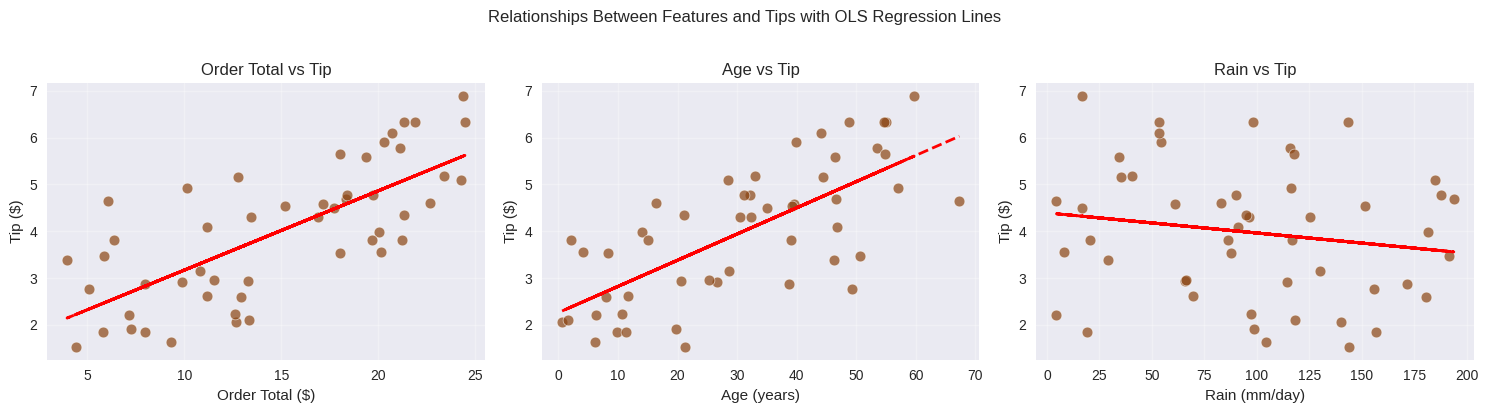
OLS
We werken altijd best met gestandaardiseerde waarden. Voor de feature matrix kunnen we handig gebruikmaken van scikit-learn’s StandardScaler.
# Standardizing
# Targets
y_mean = np.mean(observed_tips)
y_std = np.std(observed_tips)
y_scaled = (observed_tips - y_mean) / y_std

# Features
X = np.column_stack((np.ones(n_customers), order_totals, age, rain))
scaler = StandardScaler()
X_scaled = scaler.fit_transform(X)
X_scaled[:, 0] = 1.0  # reset the intercept column to all ones

# True parameter values
b1_scaled = (np.dot(np.array([b1, b2, b3, b4]), scaler.mean_) - y_mean) / y_std
b2_scaled, b3_scaled, b4_scaled = np.array([b2, b3, b4]) * scaler.scale_[1:] / y_std
We kunnen bevestigen dat we met een laag conditienummer te maken hebben, wat te verwachten is aangezien de features onafhankelijk van elkaar zijn gegenereerd.
# Confirm that there is no multicollinearity
condition_number = np.linalg.cond(X_scaled)
print(f"Condition number: {condition_number:.6f}")
Condition number: 1.133724
Toepassing van de normal equations:
XtX = X_scaled.T @ X_scaled
Xty = X_scaled.T @ y_scaled
beta = np.linalg.inv(XtX) @ Xty

print("Closed-form OLS coefficients:")
print(f"  β1 (bias): \t\t{beta[0]:.6f}\ttrue value: {b1_scaled:.6f}")
print(f"  β2 (Order Total): \t{beta[1]:.6f}\ttrue value: {b2_scaled:.6f}")
print(f"  β3 (Age): \t\t{beta[2]:.6f}\ttrue value: {b3_scaled:.6f}")
print(f"  β4 (Rain): \t\t{beta[3]:.6f}\ttrue value: {b4_scaled:.6f}")
Closed-form OLS coefficients:
β1 (bias): 0.000000 true value: -0.012221
β2 (Order Total): 0.666591 true value: 0.646223
β3 (Age): 0.636319 true value: 0.635362
β4 (Rain): -0.114367 true value: -0.115728
We kunnen zien dat de OLS oplossing zonder veel extra moeite opgeschaald kan worden naar meerdere features. Wel is het zo dat in de praktijk de kans op multicollineariteit en dus ongedefinieerde inverses stijgt, naarmate we meer features opnemen in ons model.
Gradient descent
De algemene regel voor het stapsgewijze updaten van parameterschattingen blijft ook hier:
Nog steeds gebruikmakend van de SSE loss, moeten we nu op zoek naar de gradiënt:
In de sectie over de SSE gradient zagen we dat in het algemene geval van features, de gradiënt volgende vorm heeft:
In matrix notatie kunnen we dit efficiënt reduceren tot:
Dit kunnen we als volgt implementeren.
def sse_gradient(X, y, b):
    """Compute the gradient of the SSE loss with respect to parameters b."""
    y_pred = X @ b
    residuals = y - y_pred
    gradient = -2 * X.T @ residuals
    return gradient


def loss_fn(X, y, b):
    """Compute the loss (SSE) given the input features, target values, and model parameters."""
    y_pred = X @ b
    residuals = y - y_pred
    return np.sum(residuals**2)
Voor gradient descent beginnen we steeds met een educated guess voor de parameters:
# Initial coefficients
b = np.array([1.0, 1.0, 1.0, 1.0])

# Initial loss
loss_history = [loss_fn(X_scaled, y_scaled, b)]

# Learning rate
lr = 1e-5

# Number of iterations
n_iter = 10000

for i in range(n_iter):
    grad = sse_gradient(X_scaled, y_scaled, b)
    b -= lr * grad
    loss = loss_fn(X_scaled, y_scaled, b)
    loss_history.append(loss)
    if i % 1000 == 0 or i == n_iter - 1:
        print(f"Iteration {i + 1:4d}: loss = {loss:.6f}")

print("\nGradient descent coefficients:")
print(f"  β1 (bias): \t\t{b[0]:.6f}\tols value: {beta[0]:.6f}\ttrue value: {b1_scaled:.6f}")
print(f"  β2 (Order Total): \t{b[1]:.6f}\tols value: {beta[1]:.6f}\ttrue value: {b2_scaled:.6f}")
print(f"  β3 (Age): \t\t{b[2]:.6f}\tols value: {beta[2]:.6f}\ttrue value: {b3_scaled:.6f}")
print(f"  β4 (Rain): \t\t{b[3]:.6f}\tols value: {beta[3]:.6f}\ttrue value: {b4_scaled:.6f}")
Iteration 1: loss = 124.023166
Iteration 1001: loss = 19.097274
Iteration 2001: loss = 4.451616
Iteration 3001: loss = 2.394629
Iteration 4001: loss = 2.103591
Iteration 3001: loss = 2.394629
Iteration 4001: loss = 2.103591
Iteration 5001: loss = 2.062057
Iteration 6001: loss = 2.056071
Iteration 7001: loss = 2.055198
Iteration 5001: loss = 2.062057
Iteration 6001: loss = 2.056071
Iteration 7001: loss = 2.055198
Iteration 8001: loss = 2.055069
Iteration 9001: loss = 2.055050
Iteration 8001: loss = 2.055069
Iteration 9001: loss = 2.055050
Iteration 10000: loss = 2.055047
Gradient descent coefficients:
β1 (bias): 0.000045 ols value: 0.000000 true value: -0.012221
β2 (Order Total): 0.666576 ols value: 0.666591 true value: 0.646223
β3 (Age): 0.636378 ols value: 0.636319 true value: 0.635362
β4 (Rain): -0.114291 ols value: -0.114367 true value: -0.115728
Iteration 10000: loss = 2.055047
Gradient descent coefficients:
β1 (bias): 0.000045 ols value: 0.000000 true value: -0.012221
β2 (Order Total): 0.666576 ols value: 0.666591 true value: 0.646223
β3 (Age): 0.636378 ols value: 0.636319 true value: 0.635362
β4 (Rain): -0.114291 ols value: -0.114367 true value: -0.115728