Naast PCA bestaan er andere technieken voor dimensionaliteitsreductie die specifiek ontworpen zijn om lokale structuur en non-lineaire patronen te behouden. Er zijn tegenwoordig twee belangrijke alternatieven: t-SNE (t-distributed Stochastic Neighbor Embedding) en UMAP (Uniform Manifold Approximation and Projection)
Beperkingen van PCA
Lineaire projectie: Kan alleen lineaire relaties vastleggen
Globale focus: Maximaliseert variantie, maar behoudt lokale structuur niet noodzakelijk
Euclidische afstanden: Werkt minder goed bij bepaalde structuren
t-SNE
Intuïtie
t-SNE (t-distributed Stochastic Neighbor Embedding) bewaart lokale nabijheden door punten die dicht bij elkaar liggen in de hoge-dimensionale ruimte ook dicht bij elkaar te houden in de lage-dimensionale visualisatie.
Kernidee: Converteer afstanden naar waarschijnlijkheden
In de originele hoge dimensies: Voor elk punt , bereken de waarschijnlijkheid dat het punt als “buur” kiest:
Dit is een Normaalverdeling: punten die dicht bij liggen krijgen een hoge waarschijnlijkheid.
In de target lage dimensies: Definieer analoge waarschijnlijkheden voor de lage-dimensionale punten , maar nu met een t-distributie (Student-t met 1 vrijheidsgraad):
De t-distributie heeft zwaardere staarten dan een Normaalverdeling, wat helpt om het crowding problem op te lossen (in lage dimensies is er minder ruimte voor alle punten).
Optimalisatie: Vind die de Kullback-Leibler divergentie tussen en minimaliseert:
Intuïtief: straf situaties waar groot is (punten zijn buren in hoge dimensies) maar klein is (ver uit elkaar in visualisatie).
Voordelen
Excellente clustering: Onthult natuurlijke clusters zeer duidelijk
Lokale structuur: Behoudt de nabijheid van vergelijkbare punten
Niet-lineair: Kan complexe manifold-structuren vastleggen
Beperkingen
Geen globale structuur: Afstanden tussen clusters zijn niet betekenisvol
Computationeel zwaar: complexiteit (maar algoritmes zoals Barnes-Hut reduceren dit)
Niet-deterministisch: Resultaat hangt af van initialisatie en hyperparameters
Geen nieuwe data: Geen directe transformatie voor nieuwe punten (wel approximaties)
UMAP
Intuïtie
UMAP (Uniform Manifold Approximation and Projection) is gebaseerd op de assumptie dat data op een lager-dimensionale manifold ligt in de hoge-dimensionale ruimte. Het gebruikt ideeën uit Riemannse meetkunde en topologie.
Kernidee: Bouw een graafrepresentatie van de data
Lokale afstandsmetriek: UMAP veronderstelt dat de data lokaal Euclidisch is. Voor elk punt schatten we de lokale metriek door de afstand tot de dichtstbijzijnde buur :
waar de afstand tussen punten is. Dit creëert een fuzzy graph waar edges gewichten hebben tussen 0 en 1.
Fuzzy simplicial complex: De gewichten definiëren een topologische structuur:
Punt behoort “gedeeltelijk” tot de buurt van punt
Symmetriseer:
Optimalisatie: Vind lage-dimensionale representatie met analoge graaf die benadert via cross-entropy:
Dit balanceert:
Aantrekking: Als hoog is (buren), maak ook hoog
Afstoting: Als laag is (geen buren), maak ook laag
Sleutelverschil met t-SNE: UMAP bewaart meer globale structuur door de manifold-assumptie en fuzzy topologie.
Voordelen
Sneller dan t-SNE: in plaats van , schaalbaar naar miljoenen punten
Globale + lokale structuur: Behoudt zowel clusters als hun onderlinge posities
Generaliseerbaar: Kan nieuwe data transformeren zonder opnieuw trainen
Flexibel: Werkt goed voor verschillende (niet alleen 2D)
Beperkingen
Hyperparameters: Gevoelig voor
n_neighborsenmin_distTheoretische basis: Complexere wiskunde, minder intuïtief dan PCA
Interpretatie: Afstanden in lage dimensies zijn niet direct Euclidisch
PCA vs t-SNE vs UMAP
| Eigenschap | PCA | t-SNE | UMAP |
|---|---|---|---|
| Lineair/Non-lineair | Lineair | Non-lineair | Non-lineair |
| Behoudt | Globale variantie | Lokale structuur | Lokaal + globaal |
| Snelheid | Zeer snel | Traag () | Snel () |
| Schaalbaarheid | Uitstekend | Beperkt | Uitstekend |
| Nieuwe data | Direct | Nee (approximatie) | Ja |
| Determinisme | Ja | Nee | Nee |
| Interpretatie | Duidelijk (PC’s) | Visueel | Visueel |
| Output | Embedding | Embedding | Embedding |
| Beste voor | Lineaire trends, preprocessing | Visualisatie, clusters | Algemeen, grote data |
Vuistregels voor keuze
PCA
Data is ongeveer lineair
Je wilt snelle, schaalbare dimensionaliteitsreductie
Je wilt interpreteerbare componenten
Je moet nieuwe data kunnen transformeren
t-SNE
Visualisatie is het hoofddoel
Je wilt duidelijke clusterseparatie
Dataset is niet te groot (< 10.000 punten)
Lokale structuur is belangrijker dan globale
UMAP
Je wilt zowel clusters als hun onderlinge relaties
Dataset is groot (> 10.000 punten)
Je moet nieuwe data kunnen transformeren
Je wilt verder werken met de embedding (niet alleen visualisatie)
Praktische toepassing
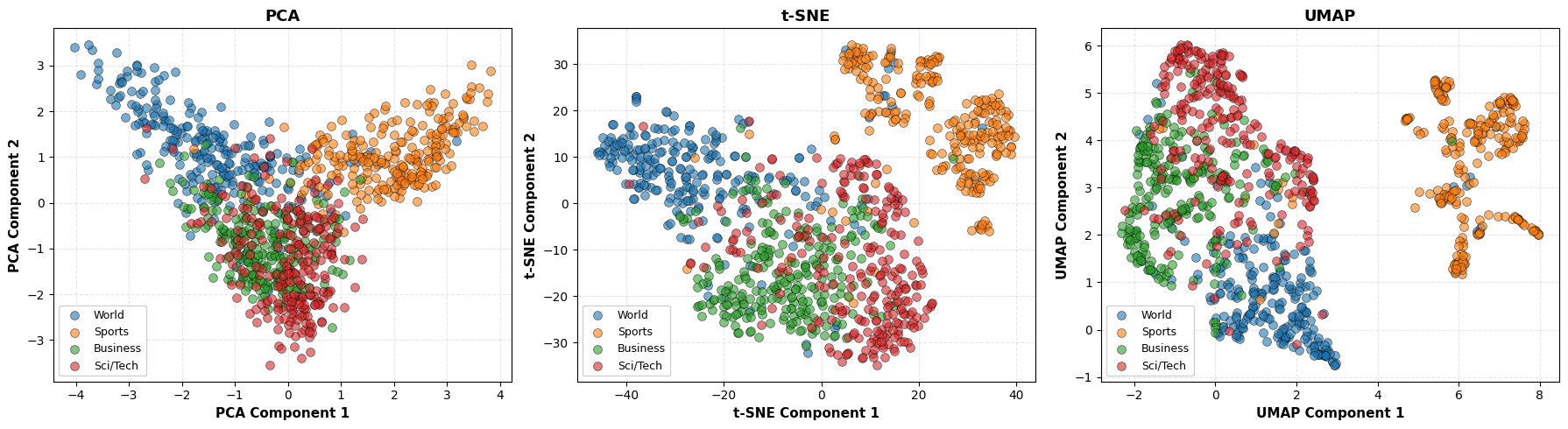
We gebruiken dezelfde AG News dataset met BERT embeddings als in het PCA notebook, maar nu vergelijken we PCA, t-SNE en UMAP naast elkaar. Dit laat zien hoe verschillende technieken dezelfde hoog-dimensionale data (768D) anders visualiseren.
Source
# Import required libraries
import matplotlib.pyplot as plt
import numpy as np
import torch
from datasets import load_dataset
from sklearn.decomposition import PCA
from sklearn.manifold import TSNE
from transformers import AutoModel, AutoTokenizer
from umap import UMAP

# Set random seed for reproducibility
rng = np.random.default_rng(42)

# 1. Load AG News dataset
dataset = load_dataset("ag_news", split="test")

# Sample 1000 articles (250 per category)
samples_per_class = 250
indices = []
for label in range(4):
    label_indices = [i for i, item in enumerate(dataset) if item["label"] == label]
    indices.extend(rng.choice(label_indices, samples_per_class, replace=False))

dataset_sampled = dataset.select(indices)
texts = [item["text"] for item in dataset_sampled]
y = np.array([item["label"] for item in dataset_sampled])
target_names = ["World", "Sports", "Business", "Sci/Tech"]

# 2. Generate BERT embeddings
tokenizer = AutoTokenizer.from_pretrained("distilbert-base-uncased")
model = AutoModel.from_pretrained("distilbert-base-uncased")
model.eval()

embeddings = []
with torch.no_grad():
    for i, text in enumerate(texts):
        if (i + 1) % 100 == 0:
            print(f"Processing article {i + 1}/{len(texts)}")

        inputs = tokenizer(text, return_tensors="pt", truncation=True, padding=True, max_length=512)
        outputs = model(**inputs)
        cls_embedding = outputs.last_hidden_state[:, 0, :].squeeze().numpy()
        embeddings.append(cls_embedding)

X_bert = np.array(embeddings)
print(f"\nBERT embeddings shape: {X_bert.shape}")
print(f"Each article is represented as a {X_bert.shape[1]}-dimensional vector")

# 3. Apply dimensionality reduction techniques

# PCA
print("Applying PCA...")
pca = PCA(n_components=2, random_state=42)
X_pca = pca.fit_transform(X_bert)
print(f"  Explained variance: {pca.explained_variance_ratio_.sum():.2%}")

# t-SNE
print("Applying t-SNE (this may take a minute)...")
tsne = TSNE(n_components=2, random_state=42, perplexity=30, max_iter=1000)
X_tsne = tsne.fit_transform(X_bert)
print("  t-SNE complete")

# UMAP
print("Applying UMAP...")
umap = UMAP(n_components=2, random_state=42, n_neighbors=15, min_dist=0.1)
X_umap = umap.fit_transform(X_bert)
print("  UMAP complete")

print("\nAll transformations complete!")
Output
Processing article 100/1000
Processing article 200/1000
Processing article 300/1000
Processing article 400/1000
Processing article 500/1000
Processing article 600/1000
Processing article 700/1000
Processing article 800/1000
Processing article 900/1000
Processing article 1000/1000

BERT embeddings shape: (1000, 768)
Each article is represented as a 768-dimensional vector
Applying PCA...
  Explained variance: 19.54%
Applying t-SNE (this may take a minute)...
  t-SNE complete
Applying UMAP...
/opt/venv/lib/python3.10/site-packages/umap/umap_.py:1952: UserWarning: n_jobs value 1 overridden to 1 by setting random_state. Use no seed for parallelism.
  warn(
  UMAP complete

All transformations complete!
Source
# 4. Visualize all three methods side-by-side
fig, axes = plt.subplots(1, 3, figsize=(18, 5))

colors = ["#1f77b4", "#ff7f0e", "#2ca02c", "#d62728"]
titles = ["PCA", "t-SNE", "UMAP"]
embeddings = [X_pca, X_tsne, X_umap]

for ax, title, X_embedded in zip(axes, titles, embeddings, strict=True):
    for i, (name, color) in enumerate(zip(target_names, colors, strict=True)):
        mask = y == i
        ax.scatter(
            X_embedded[mask, 0],
            X_embedded[mask, 1],
            c=color,
            label=name,
            alpha=0.6,
            s=50,
            edgecolors="k",
            linewidth=0.5,
        )

    ax.set_xlabel(f"{title} Component 1", fontsize=11, fontweight="bold")
    ax.set_ylabel(f"{title} Component 2", fontsize=11, fontweight="bold")
    ax.set_title(f"{title}", fontsize=13, fontweight="bold")
    ax.legend(loc="best", framealpha=0.9, fontsize=9)
    ax.grid(True, alpha=0.3, linestyle="--")

plt.tight_layout()
plt.show()